

THE BIBLIOMETRIC LENS
The research profiles of Germany’s federal states
AUTHOR: Andrey Lovakov
PUBLISHED: July 19, 2026
AFFILIATION: German Centre for Higher Education Research and Science Studies (DZHW)
A comparison of the disciplinary research profiles of Germany’s federal states and their university and research sectors reveals that the profiles of most federal states are similar to the national profile. Specialization is largely confined to smaller states. Within each state, the university and research sectors overlap considerably, though the degree varies. The research institutes that a state hosts are its main source of distinctiveness.
Research is not evenly distributed across scientific fields. The amount of work produced in physics or the humanities depends not only on how funding and personnel are distributed across disciplines, but also on deeper structural factors. These include a region’s economic base, geography, political history and the locations of universities and research institutes.
The German research system is genuinely federal. Universities are primarily governed and financed by the sixteen federal states, meaning each federal state directly shapes its own university sector. Alongside the universities, the German academic system includes a second pillar. This pillar consists of a dense network of research institutes, which are mainly organized into four large associations: the Max Planck Society, the Helmholtz Association, the Fraunhofer Society, and the Leibniz Association. These institutes are jointly funded by the federal and state governments and operate as national organizations. Consequently, their disciplinary orientation and location depend more on national priorities and historical circumstances than on any single federal state.
This blogpost addresses two questions. The first is whether the federal states have different disciplinary research profiles. The second is whether the university and research sectors within each federal state share a common research profile or pursue different ones.
Data and methodology
The in-house version of the Scopus database provided by the German Competence Network for Bibliometrics (snapshot as of 10.2025) was used (Schmidt et al. 2025). The analysis covers journal articles and reviews published between 2020 and 2024 with at least one author affiliated in Germany. Each publication was assigned to one of 26 broad fields (excluding the “Multidisciplinary” category), to one or more of the sixteen federal states, and to one or both of two sectors. The university sector includes universities and universities of applied sciences. The research sector includes the institutes of the four mission-oriented associations: the Max Planck Society, the Helmholtz Association, the Fraunhofer Society, and the Leibniz Association. As publications can be co-authored across sectors, the same paper may contribute to both sectors.
In order to compare federal states of very different sizes, we do not count publications directly, as larger federal states produce more in almost every field, which tells us little about their character. Instead, we measure relative specialization (Aksnes, van Leeuwen, and Sivertsen 2014). First, we calculate the activity index (AI) for each field. This is the field’s share of a federal state’s output divided by its share of Germany’s overall output. An AI above 1 indicates that the field is over-represented in that federal state, accounting for a larger proportion of its research output than at the national level. An AI below 1 suggests under-representation. The activity index ranges from 0 to infinity and is asymmetric. We therefore transform it into the relative specialization index (RSI), defined as (AI − 1) / (AI + 1). The RSI ranges from −1 to +1: positive values indicate over-representation, negative values indicate under-representation, and a value of zero indicates that a field takes up exactly the same share of a federal state’s output as of Germany’s overall output. As the RSI is symmetric around zero, an RSI of +0.5 and one of −0.5 represent departures of equal size in opposite directions. The RSI is a relative measure of a field’s prominence within a federal state’s own output, not an absolute size. A positive RSI means that a field carries more weight in a federal state’s profile than nationally, rather than indicating that the federal state produces a higher volume of papers in that field than other states. A field that is over-represented in a small federal state may be larger, in absolute terms, in a large one. Throughout the following text, ‘over-represented’ and ‘under-represented’ should be understood in this relative sense.
The same logic was applied to answer the second question, but this time the federal state’s total output was used as the benchmark instead of the national output. The RSI of each sector was then computed against this benchmark. To summarize the similarity between two sectors, their disciplinary profile overlap was considered. The proportion of research that the two sectors have in common ranges from 0% (no overlap) to 100% (identical profiles).
How do the federal states differ?
The research profiles of most federal states are fairly close to the national average. Significant specialization is the exception rather than the rule. As can be seen in the heatmap below (Figure 1), the vast majority of values fall within a narrow range around zero. Strong over- or under-representation is confined to a few federal states and fields. These profiles are shaped by several structural factors. The economic base of a federal state, its geography, and the historical and political decisions regarding the location of research institutions all influence its disciplinary mix. Another factor is the size and diversity of the federal state’s research system itself. A large, diversified system aggregates many institutions and tends to resemble the national average, whereas a small system can be visibly impacted by a single large institution or industry. This is one reason why smaller federal states such as Saarland, Bremen, Brandenburg, and Mecklenburg-Western Pomerania tend to have distinctive profiles, while larger federal states such as North Rhine-Westphalia, Bavaria and Baden-Württemberg appear comparatively unspecialized.
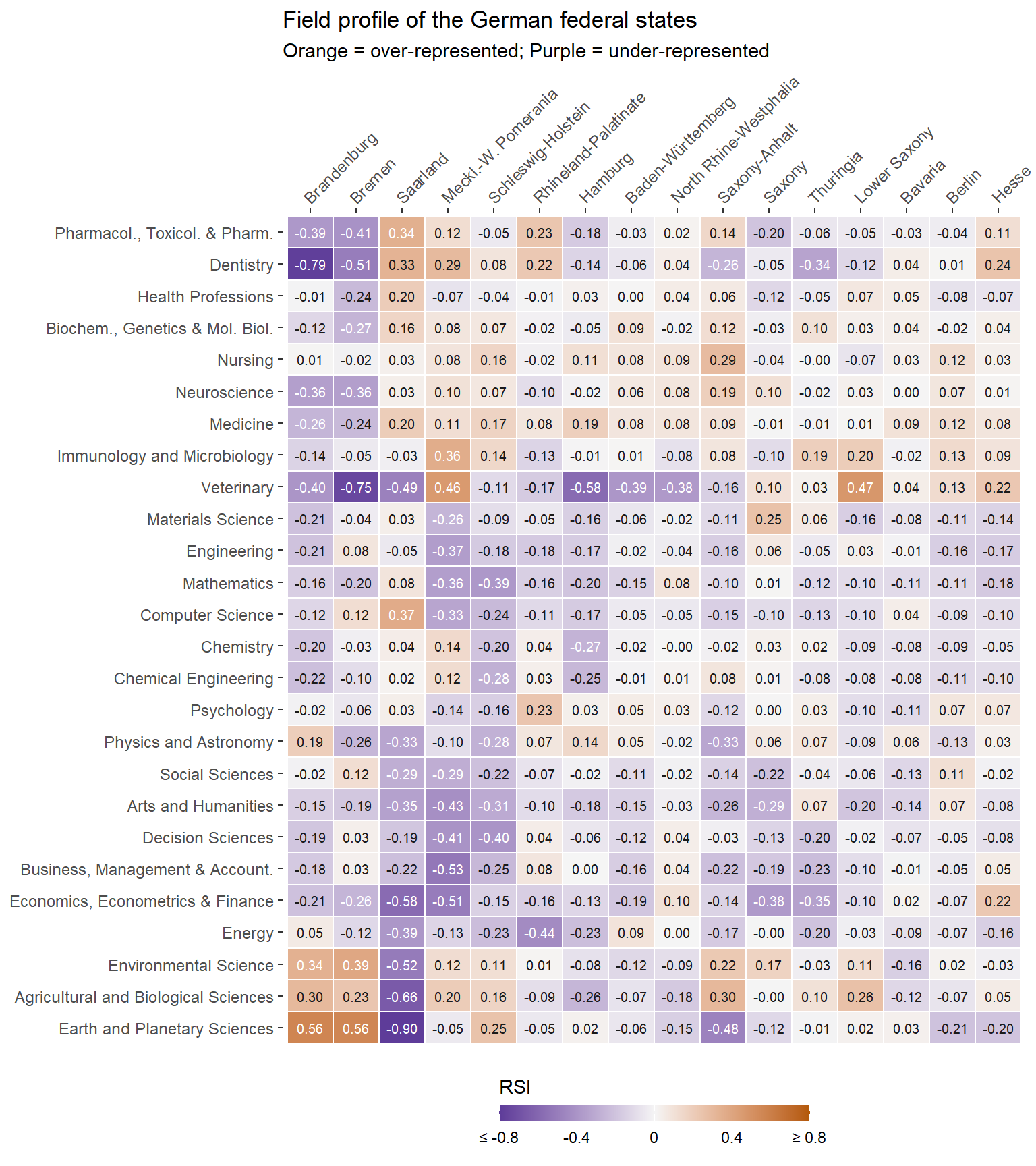
Figure 1: Relative specialization (RSI) of each federal state by field.
The pattern of over-representation can be broadly interpreted in structural terms. Earth, environmental, agricultural and biological sciences are over-represented in several northern and eastern federal states, as well as along the coast. The RSI for earth and planetary sciences is +0.56 in both Brandenburg and Bremen, meaning that these fields account for a much larger proportion of the output of these federal states than of Germany as a whole. This is consistent with geographical factors, such as coastal locations favouring marine research and the presence of large geoscience, marine, and agricultural institutes. Several of these institutes were established or expanded in the eastern federal states after reunification. Similarly, veterinary medicine is over-represented in Lower Saxony (+0.47) and Mecklenburg-Western Pomerania (+0.46), consistent with the long-established veterinary university in Hannover, regional animal health institutes, and the agricultural nature of these federal states. It’s important to note that this doesn’t mean these federal states produce the most veterinary research in absolute terms, but rather that the field is comparatively prominent within their own research output.
Other over-representations reflect economic structure and deliberate research policy. For example, computer science is significantly over-represented in Saarland (+0.37), reflecting the region’s long-standing focus on informatics. As Saarland’s overall output is modest, this focus significantly impacts its profile. Other examples include materials science, which is over-represented in Saxony (+0.25), in line with the industrial and technological history of the Dresden region, and economics and finance in Hesse (+0.22), where Frankfurt is the country’s financial centre. Psychology is over-represented in Rhineland-Palatinate (+0.23). The social sciences and humanities present a distinctive case: they are over-represented almost exclusively in Berlin (and in Bremen for the social sciences) and under-represented across most of the more specialized federal states. Berlin hosts an unusually dense and varied set of universities and social science institutions. Elsewhere, these fields tend to be outweighed wherever large natural science institutes dominate a federal state’s output.
As a federal state’s field shares must sum to a fixed total, strong over-representation in one area necessarily implies under-representation in others. Consequently, the federal states with a strong focus on natural sciences tend to under-represent economics, business, and the humanities. For example, Mecklenburg-Western Pomerania has values of −0.53 for business, −0.51 for economics, and −0.43 for the arts and humanities. Saarland has values of −0.58 for economics and −0.66 for agriculture. The most extreme negative values usually indicate a field’s near-absence from a federal state rather than an active de-emphasis. Saarland’s value of −0.90 in earth sciences reflects this. A related caution applies to small fields such as veterinary and dentistry, whose share can fluctuate significantly in a small federal state based on a single institution. Therefore, extreme values in these fields should be interpreted with caution. Figure 2 summarizes the five most over- and under-represented fields in each federal state.
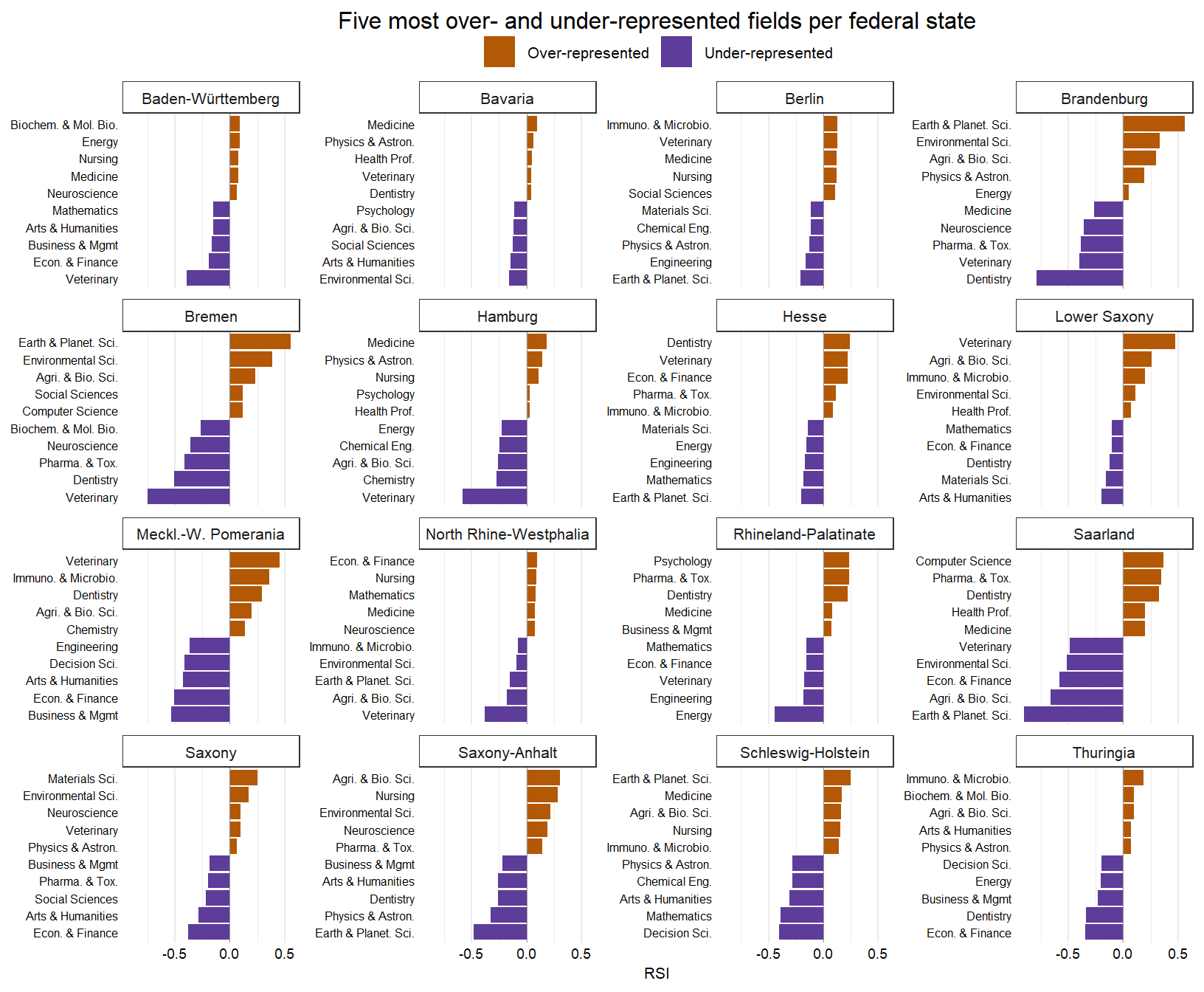
over_under_representated
Figure 2: Five most over- and under-represented fields in each German federal state.
To summarize how distinctive a federal state is overall, its specialisation intensity was calculated. This shows how far a federal state’s field profile deviates from the national profile. It is calculated as the proportion of a federal state’s output that would need to be redistributed across fields to align with Germany’s profile. A value of 0 means the profile is identical to the national profile, while larger values mean a more distinctive profile. As Figure 3 shows, this intensity is strongly related to the size of the research system (Spearman’s ρ = ‑0.73). The larger a federal state’s publication output, the closer its profile is to the national profile. The most distinctive profiles belong to Brandenburg, Bremen, Saarland, and the least distinctive to North Rhine-Westphalia, Thuringia, Baden-Württemberg. This is partly structural, as large and diverse systems aggregate many institutions and move towards a national profile. It is also partly mechanical, as small shares of output in a field are more easily influenced by a single institution. The fact that city-states, which are geographically small but large in output, sit close to the national profile suggests that the effect is driven by the size of the research system rather than the physical size of a federal state.
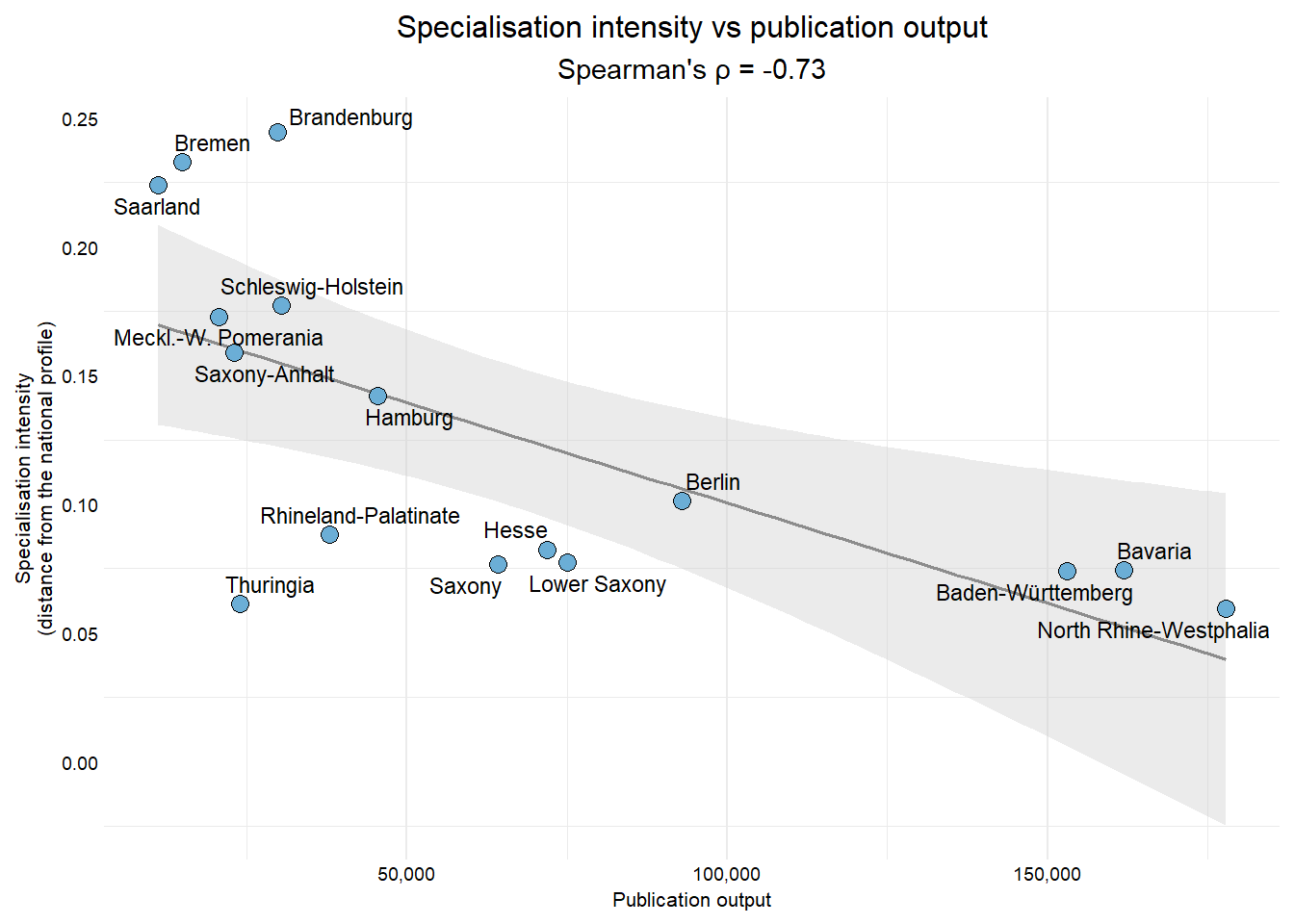
intensity_publication
Figure 3: Specialisation intensity versus publication output.
How do the university and research sectors differ within federal states?
The second question shifts the focus from comparisons between federal states to comparisons within them. This is where the federal structure of the German system becomes directly relevant. While the federal states govern and finance their own universities, they do not directly steer the research institutes, which are jointly funded by the federal government and are located in areas determined by national and historical factors. If the two sectors were shaped by different forces, one might expect them to have different research profiles. To examine this, we calculate the degree of specialization in each sector against the federal state’s overall profile and summarize the results by overlaying the two sectors’ disciplinary profiles.
The first finding is that the two sectors generally agree with each other across all federal states. The overlap between the university and research profiles ranges from about 76% in Baden-Württemberg down to 57% in Hamburg (see Figure 4). Even in the most divergent case, the two sectors still share a majority of their disciplinary profile.
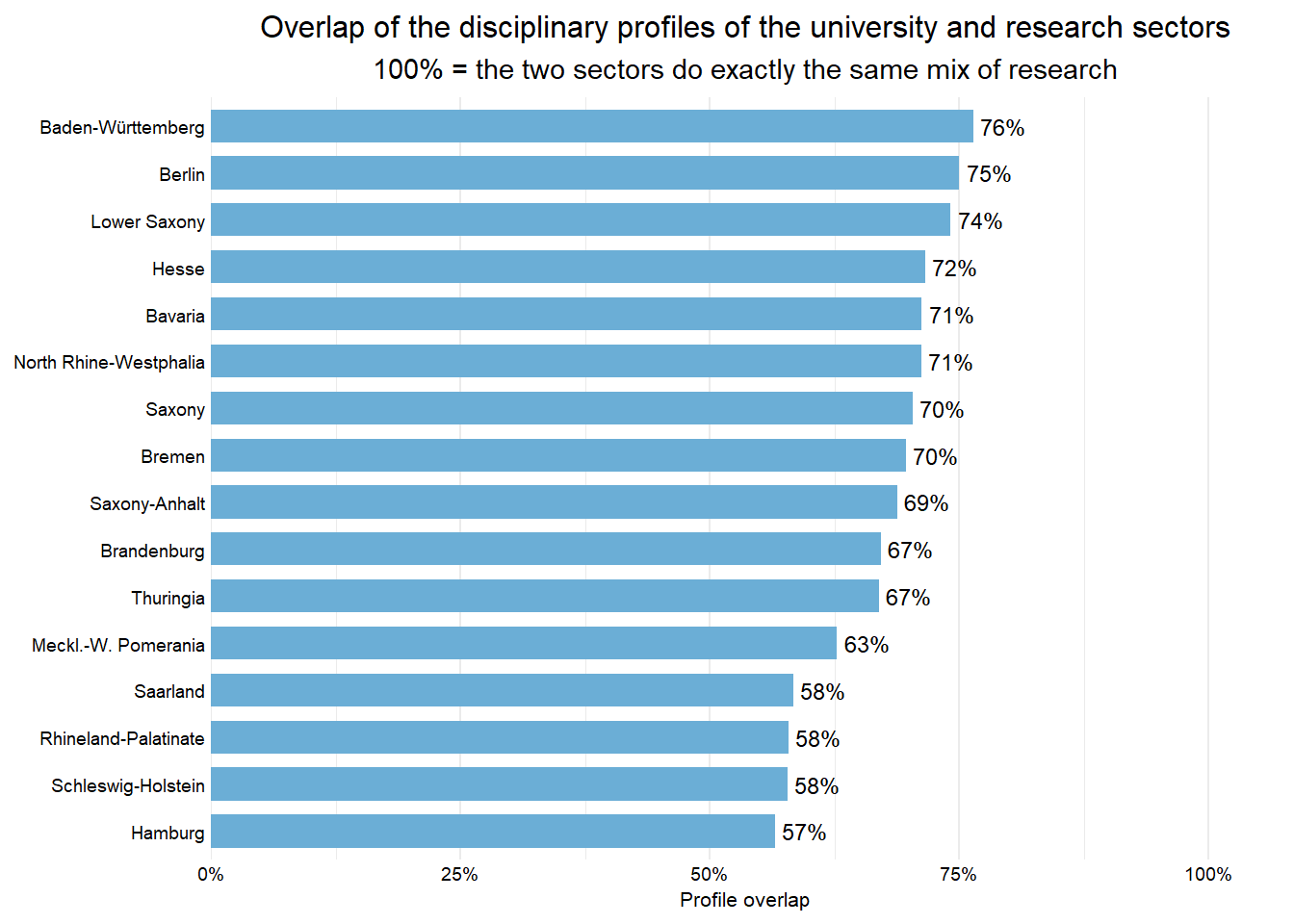
overlap
Figure 4: Overlap of the disciplinary profiles of the university and research sectors.
There is a consistent divergence between the two sectors. In every federal state, the university sector is comparatively over-represented in the social, human and clinical fields, such as the arts and humanities, social sciences, psychology, business, economics, dentistry, nursing and health professions, and usually mathematics and medicine. Meanwhile, the research sector is comparatively over-represented in the physical and environmental sciences, including earth and planetary sciences, materials science, physics, energy, engineering, chemistry, and some areas of the life sciences. This reflects the structure of the German system, in which the humanities, social sciences, and clinical disciplines are predominantly in the university sector. Mission-oriented research associations concentrate in the natural sciences. The magnitude of this division of labor varies between federal states, but not the direction.
The size of a federal state and the institutions it hosts shape this magnitude. In large, diversified federal states, both sectors reflect the federal state’s overall profile and therefore resemble each other. In small federal states, by contrast, the research sector is often dominated by one or two large institutes, which pull its profile away from that of the universities. The federal states with the most aligned sectors are, accordingly, among the larger systems: Baden-Württemberg (76%), Berlin (75%), Lower Saxony (74%), Hesse (72%). The most divergent are smaller states: Hamburg (57%), Schleswig-Holstein (58%), Rhineland-Palatinate (58%), Saarland (58%).
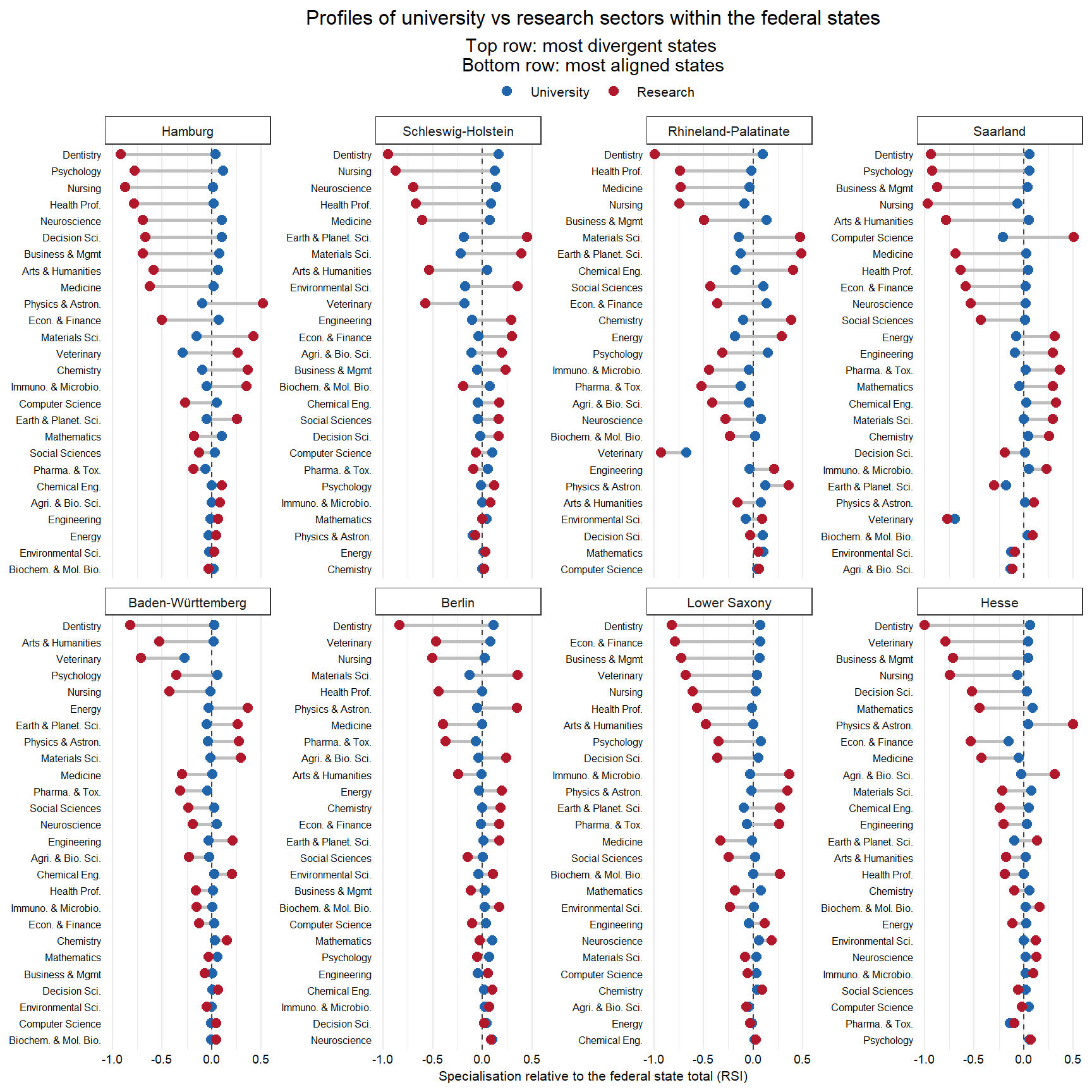
The divergent federal states demonstrate how a single institutional cluster can influence a sector. In Saarland, for example, the research sector is strongly over-represented in computer science relative to the federal state’s overall profile, while the university sector is under-represented there. The research sector also leans towards materials, pharmaceuticals, energy and engineering, and largely lacks representation in the humanities, business and psychology, which are mostly represented in the universities. This reflects the informatics-focused institutes located in Saarbrücken. In Schleswig-Holstein, the research sector specializes in earth and planetary sciences, materials science, and environmental science. This is consistent with the marine and geoscience institutions along the Kiel coast, while the universities carry dentistry, nursing, neuroscience, and the health professions. Hamburg shows a similar split, with its research sector markedly over-represented in physics and astronomy and, to a lesser extent, in materials and chemistry. Its universities specialize in dentistry, psychology, nursing, and clinical fields. Rhineland-Palatinate completes the group. Its research sector leans towards materials, earth sciences and chemical engineering, while its universities focus on dentistry, medicine and the health-related professions. In every case, the divergence runs in the same direction: the research sector specializes in the physical and environmental sciences, the universities specialize in the social, human and clinical fields. Figure 5 shows these contrasts field by field for the most divergent and most aligned federal states.
profiles
Figure 5: Profiles of university vs research sectors within the federal states.
The same division of labour is present in the most aligned federal states, though it is less pronounced. In Berlin, the two sectors are nearly indistinguishable across the majority of fields and differ only in a few fields. The research sector is somewhat over-represented in physics and astronomy and materials, and the universities are over-represented in dentistry and veterinary medicine. The diversity of its universities and the density of its institutes mirror the federal state’s overall profile. In Hesse, the sectors also agree across most fields. The research sector focuses on physics and astronomy and chemistry, while the universities are over-represented in dentistry, business and the clinical fields. In Baden-Württemberg and Lower Saxony, the universities closely reflect the federal states’ overall profiles. The main source of divergence is the research sector, which is under-represented in the humanities, psychology, and the social sciences, but over-represented in parts of the physical and environmental sciences, such as physics, earth sciences, materials and energy.
Conclusion
Taken together, the two analyses point in the same direction. The university sector directly governed by the federal states tends to closely align with each state’s overall profile. In contrast, the research sector, which is not directly controlled by the federal states, is the main source of differences between federal states and between the two sectors within a federal state. However, one caution should be noted. The extent to which universities closely track a federal state’s overall profile depends partly on the size of the university sector. This is because universities account for a larger share of output, which pulls the overall profile toward them. The substantive point nonetheless holds. Much of what shapes a federal state’s research profile and the particular shape of its two sectors can be traced to the research institutes it hosts and the economic, geographic, historical, and political circumstances that brought them there.
References
Aksnes, Dag W., Thed N. van Leeuwen, and Gunnar Sivertsen. 2014. “The Effect of Booming Countries on Changes in the Relative Specialization Index (RSI) on Country Level.” Scientometrics 101 (2): 1391–401. https://doi.org/10.1007/s11192-014‑1245‑3.
Schmidt, Marion, Christine Rimmert, Dimity Stephen, Christopher Lenke, Paul Donner, Simone Gärtner, Niels Taubert, Thomas Bausenwein, and Stephan Stahlschmidt. 2025. “The Data Infrastructure of the German Kompetenznetzwerk Bibliometrie: An Enabling Intermediary Between Raw Data and Analysis.” Quantitative Science Studies 6: 1129–46. https://doi.org/10.1162/qss.a.20.

