

THE BIBLIOMETRIC LENS
Mobility patterns and research performance of researchers connected to Germany
AUTHOR: Andrey Lovakov
PUBLISHED: August 11, 2026
AFFILIATION: German Centre for Higher Education Research and Science Studies (DZHW)
Almost half of all researchers with ties to Germany have worked abroad at some point in their careers, and their research performance tends to be higher than that of their peers who remained in Germany. This blog post uses large-scale bibliometric data to examine mobility patterns and performance differences across five mobility groups with important implications for science policy and the openness of the German research system.
International mobility has become a defining feature of modern scientific careers. Researchers often move between countries for doctoral training, postdoctoral positions, and faculty jobs, and international collaboration is now standard practice in many fields. As a result, national research systems are becoming more integrated into the global flows of scientific talent. Germany is no exception. Universities and research institutes attract researchers from abroad, while many scholars trained in Germany spend part of their careers in other countries. At the same time, migration has become one of the most debated topics in German public discourse. Public discussions often focus on labor markets, demographic change, and the integration of migrants. Highly skilled migration, however, receives less attention outside of specialized policy debates, even though it plays a crucial role in the functioning of research systems. Against this background, it is useful to better understand how international mobility shapes the German science system. Two questions are particularly relevant: First, how internationally mobile are researchers in Germany? Second, do researchers with different mobility patterns differ in their research performance? Using large-scale bibliometric data, this blog post examines mobility trajectories and research performance for more than 300,000 researchers connected to Germany.
Data and identifying mobility
The in-house version of the Scopus database provided by the German Competence Network for Bibliometrics (snapshot as of 10.2025) was used (Schmidt et al. 2025). Elsevier disambiguates authors in Scopus by grouping all publications into profiles with a unique author IDs. The Scopus author ID was used to identify all publications for each author. All publications and affiliations linked to a given author ID were treated as belonging to the same researcher. The initial sample included all authors who had published at least one document with a German institutional affiliation between 2000 and 2025.
To study mobility, we reconstructed individual affiliation trajectories at the country level. For each researcher and publication year, the modal country of affiliation was identified, meaning the country that appeared most frequently across that researcher’s publications in that year. When two or more countries were equally frequently in a given year, they were compared to the modal country from the previous year. If one of the tied countries matched the previous year’s modal country, that country was assigned. If none matched, one country was selected at random. To account for short gaps in publication activity and reduce the artificial fragmentation of mobility sequences, publication years were extended backward by two years. This procedure produced a longitudinal country-level trajectory for each researcher
Based on these trajectories, the researchers were classified into five mutually exclusive mobility types:
- Locals: The modal country of affiliation was Germany throughout the entire observed period.
- Arrivals: The initial modal country is not Germany and the final modal country is Germany.
- Leavers: The initial modal country is Germany and the final modal country is not Germany.
- Returnees: The initial modal country is Germany, subsequent affiliation are abroad, and the final modal country is Germany.
- Visitors: The initial modal country is not Germany, temporary affiliation is Germany, and the final modal country is not Germany.
To ensure reliable identification of mobility and stable productivity indicators, the analytical sample was restricted to researchers with at least three publications and at least two years between their first and last publication year. These researchers should have been active in recent years, which is defined as a first publication year ≤ 2022 and a last publication year ≥ 2023. After applying these criteria, the final sample included 317,314 researchers.
How international is the German research system?
The results show that most researchers connected to Germany are Locals (Figure 1). About 57% of the sample remained affiliated with Germany throughout the observed period. At the same time, international mobility is far from marginal. Roughly 43% of researchers fall into one of the internationally mobile categories. Among these, Arrivals and Leavers each account for about 13% of the sample. Visitors represent 12%, while Returnees make up about 5%. These figures suggest that the German science system is deeply embedded in international mobility flows. Researchers both enter and leave the system, and some return after spending time abroad.
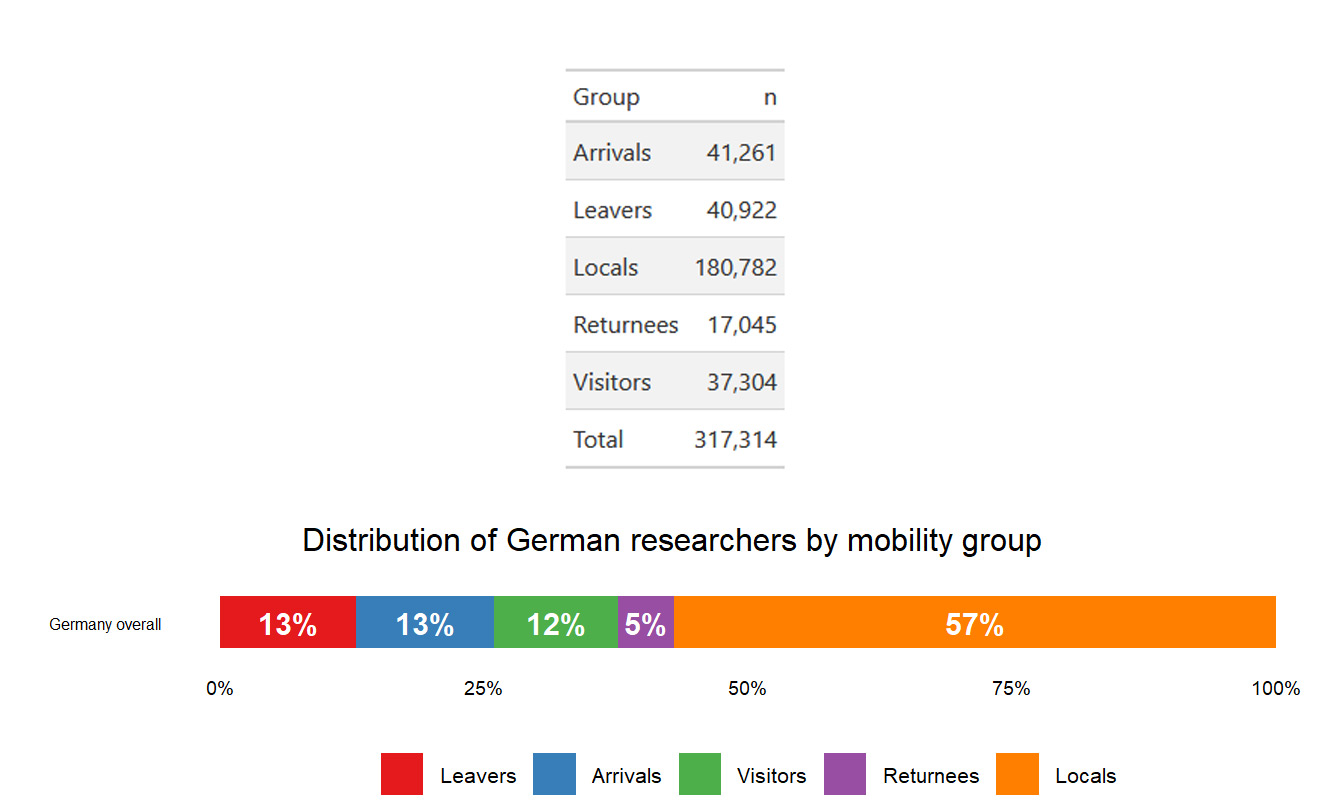
Figure 1: Distribution of German researchers by mobility group.
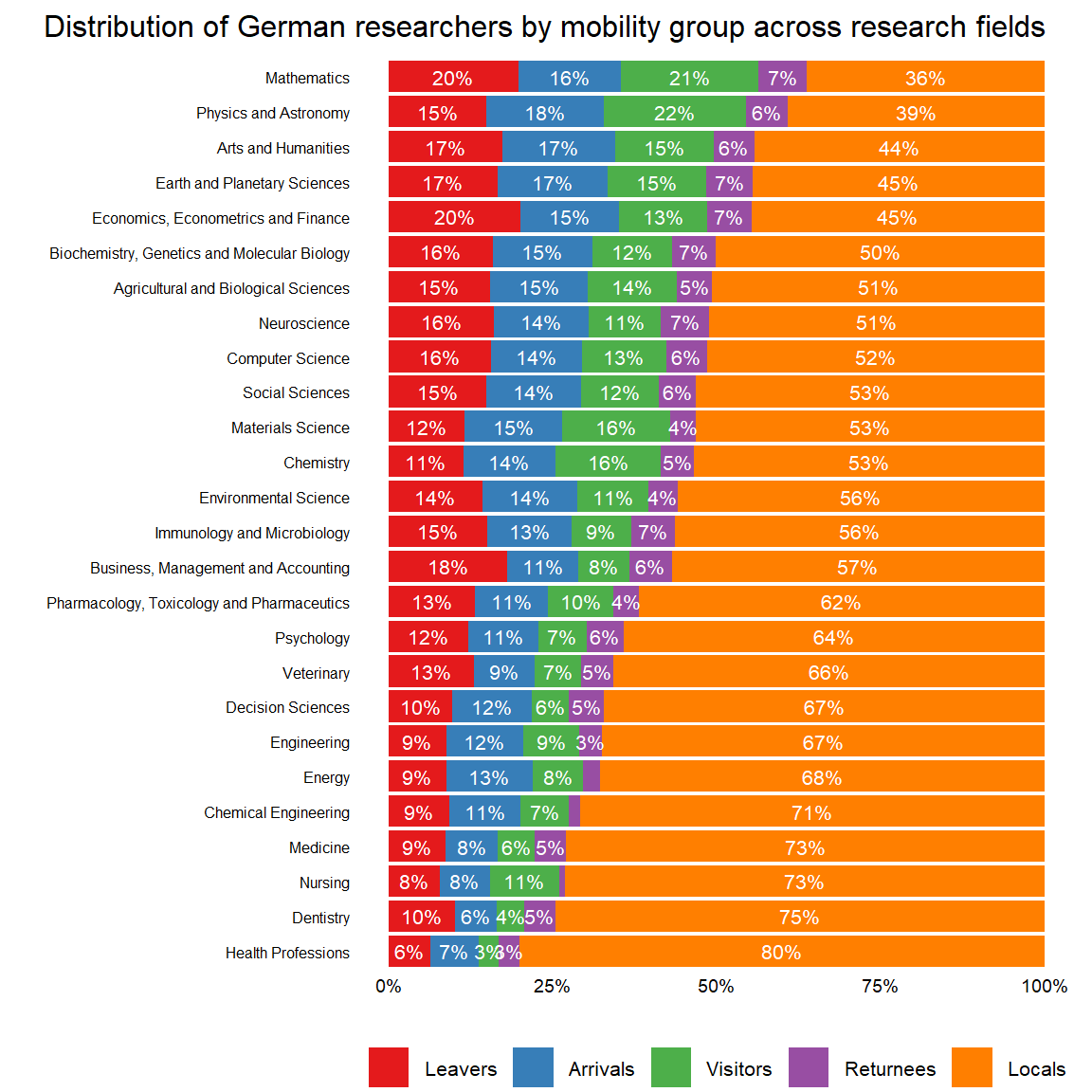
However, the degree of internationalization varies greatly across research fields (Figure 2). Highly international fields include mathematics, physics and astronomy, arts and humanities, earth and planetary sciences, and economics, econometrics and finance. In these disciplines, less than half of researchers remain locals. By contrast, fields such as health professions, dentistry, nursing, medicine, and chemical engineering show much higher shares of locals, exceeding 70%. These disciplines appear more strongly embedded in national institutional and professional structures.
research_fields
Figure 2: Distribution of German researchers by mobility group across research fields.
Do mobile researchers perform differently?
The analysis also examined whether researchers with different mobility patterns differ in their research performance. Research performance was measured using several indicators, including:
- number of publications: Articles, Reviews, and Books;
- number of publications in high-prestige journals: Level 2 of the Norwegian Register for Scientific Journals;
- mean field-normalized citation rates: the average number of citations per paper normalized by subject category and publication year, calculated using three citation windows: 3‑year window, 5‑year window, and full citation window;
- number of top 10% most cited publications: number of publications ranking among the top 10% most cited papers globally within their field and publication year, computed for 3‑year, 5‑year, and full citation windows.
The indicators were calculated using both whole and fractional counting methods and with different citation windows. All indicators were computed using both whole counting, in which each co-authored publication is fully counts for each author, and fractional counting, in which publication credit is divided by the number of co-authors. To control for the influence of large-scale collaborations, where individual contributions are difficult to assess, all indicators were calculated using two sets of publications. One set included all publications, while the other included only publications with fewer than 20 authors.
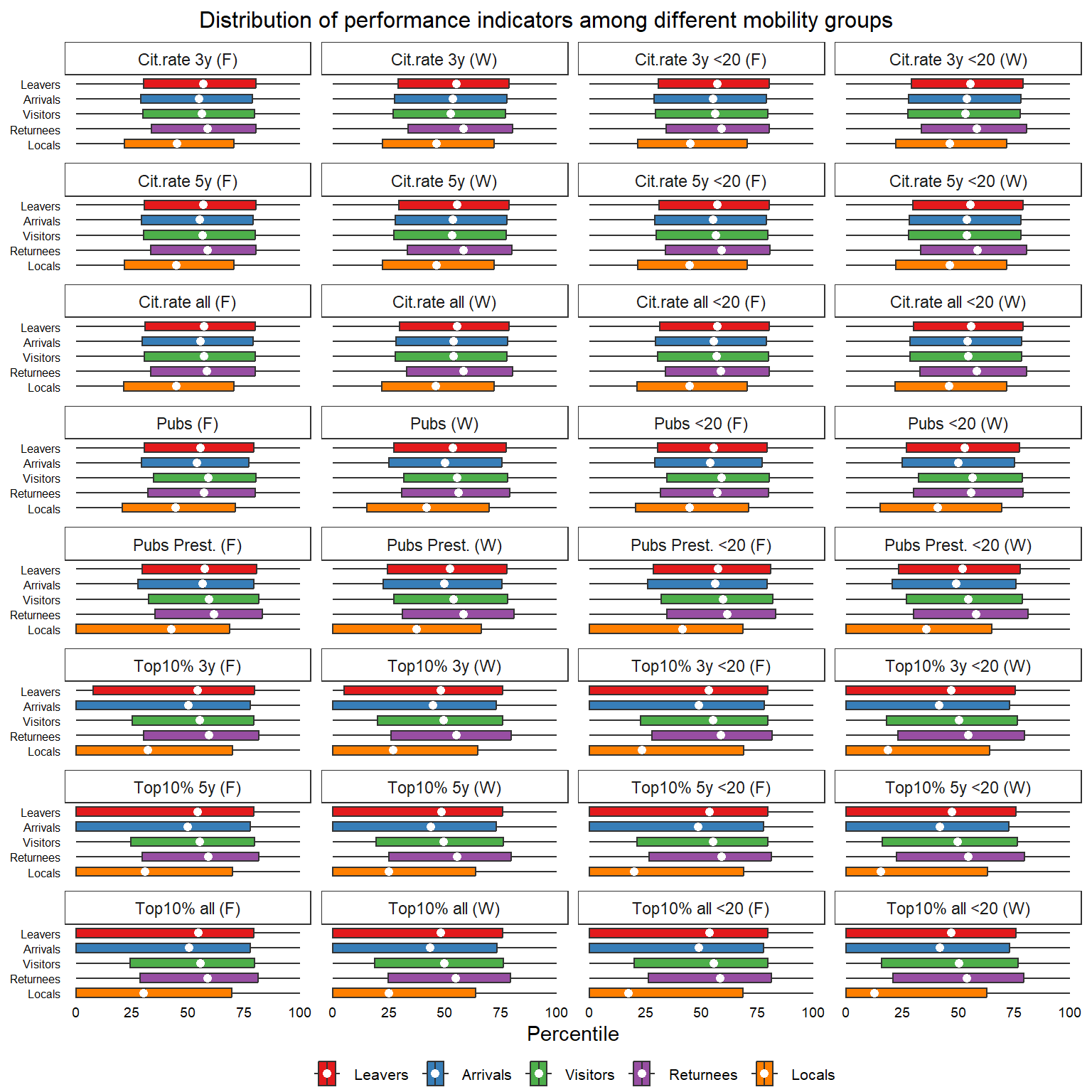
Indicator labels follow the structure [Metric] [variant] [team filter] ([counting]). Pubs = number of publications; Prest. = publications in prestige journals (Norwegian Register, Level 2); Cit.rate = mean field-normalized citation rate; Top10% = number of top 10% most cited publications. Citation windows: 3y = 3‑year, 5y = 5‑year, all = full window. <20 = restricted to publications with fewer than 20 authors. (W) = whole counting; (F) = fractional counting.
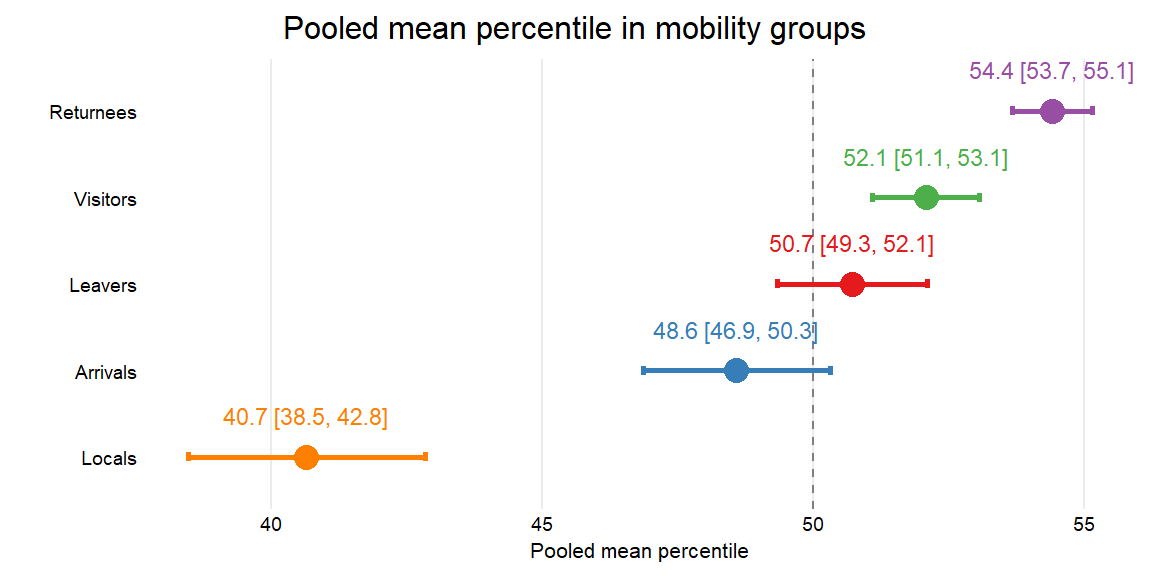
To allow meaningful comparisons across disciplines and career stages, all indicators were converted into percentiles within fields and academic age groups. A percentile of 90 means that a researcher’s indicator value is higher than 90% of other researchers in their field and academic age group. Next, weighted mean percentiles were calculated for each mobility group. Finally, the results across all indicators were synthesized using a random-effects meta-analysis.
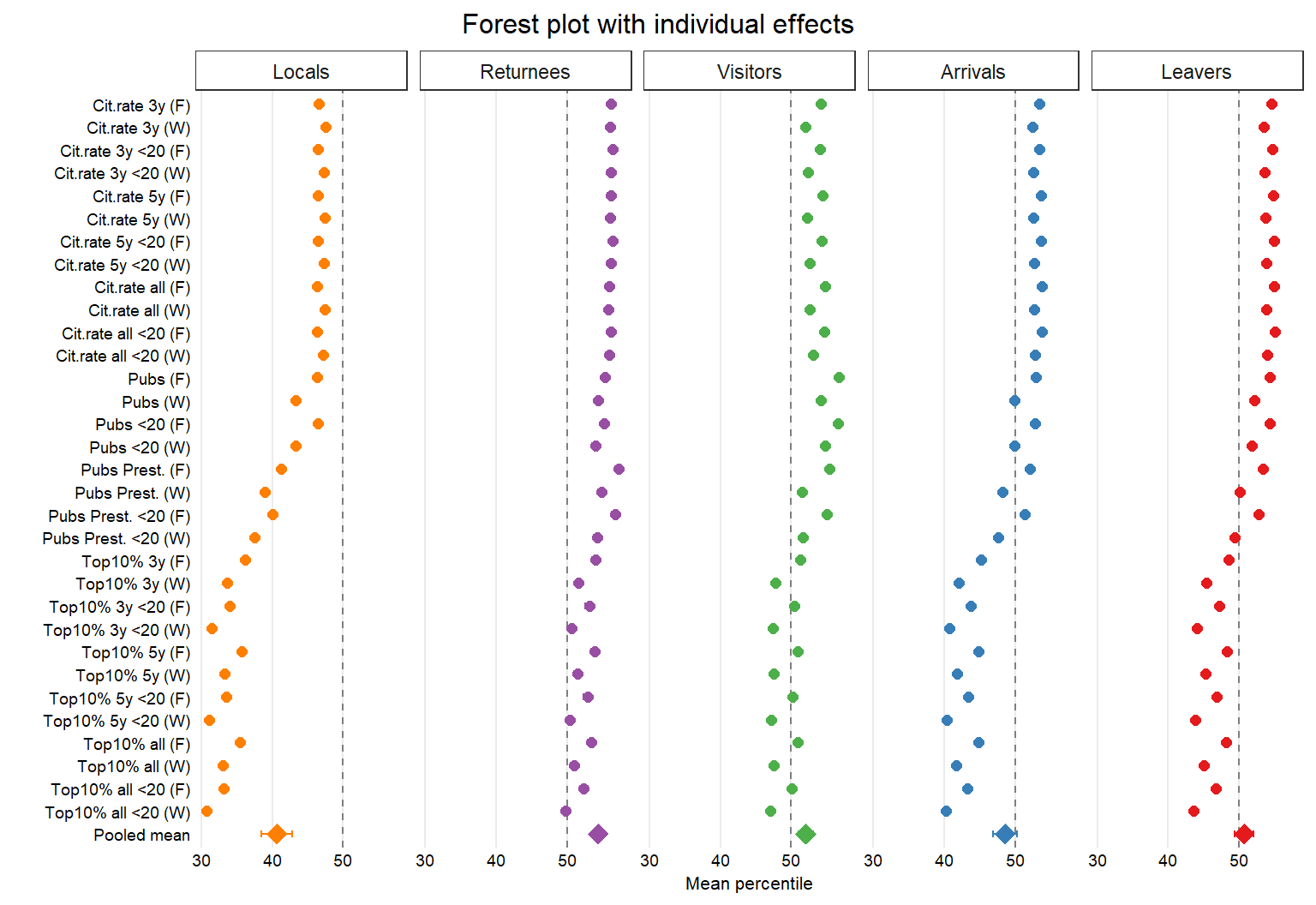
The results show a consistent pattern. Locals have the lowest median performance across all 32 indicators, with mean percentiles below 50 (Figure 3). This indicates that, on average, researchers in this group are in the lower half of the performance distribution. In contrast, Returnees and Visitors show the highest average performance levels. Their mean percentiles are typically above 50, placing them in the upper half of the distribution (Figure 4). Arrivals and Leavers fall between these two extremes, with mean percentiles both above and below the median, depending on the indicator (Figure 5). However, it is important to note that these differences are averages. The distributions overlap significantly (Figure 3). Each mobility group includes researchers with both very high and very low performance.
performance_indicators
Figure 3: Distribution of performance indicators among different mobility groups.
indiv_effects
Figure 4: Forest plot with individual effects.
pooled_mean
Figure 5: Pooled mean percentile in mobility groups.
The results above are based on all researchers in the sample. To explore the same figures for individual research fields, an interactive companion app is available here.
What do these results mean?
The results are not entirely surprising. Previous studies have already shown a positive relationship between international mobility and individual research performance. This relationship is likely bidirectional. On the one hand, mobility may improve research performance. Working in different countries can provide access to valuable resources, expand professional networks, and expose researchers to new research infrastructures, institutional environments, and funding opportunities. These experiences may help researchers develop new collaborations and increase the visibility of their work. On the other hand, mobility may also reflect selection processes. Researchers with strong publication records and promising career prospects are more likely to receive opportunities to work abroad. In this sense, internationally mobile researchers may already belong to the more successful members of the scientific workforce before they move.
It is also important to keep in mind that the groups being compared here may differ not only in their mobility patterns, but potentially also in their composition. Although all indicators were normalized by field and academic age, the groups may still differ in ways that these adjustments do not capture. The Locals group is the largest and is likely to be the most heterogeneous. For example, it may include researchers in predominantly teaching-oriented positions, at universities of applied sciences, or working part-time. All of these characteristics can limit publication output without reflecting lower research ability. By contrast, internationally mobile researchers may represent a more selective group within the research workforce. These compositional differences should be kept in mind when interpreting the performance gaps between groups.
From a science policy perspective, the findings nevertheless highlight the importance of international mobility as a structural feature of the German research system. International mobility is not marginal but a central component of how the system operates. Germany is a highly internationalized research environment that both attracts researchers from abroad and sends researchers to other countries. Scientific careers connected to Germany are therefore often shaped by international mobility. The results suggest that Germany benefits from this global circulation of researchers. Internationally mobile groups tend to show higher average performance levels than the Locals group, though this pattern may partly reflect the compositional differences discussed above. This underlines the importance of maintaining openness to international researchers. At the same time, the finding that researchers who leave Germany also tend to perform above the overall average may raise questions about how attractive the German research system is for retaining productive scientists. Finally, the findings highlight the potential importance of return mobility. Researchers who spent time abroad and later returned to Germany show the highest average performance levels among all mobility groups. Temporary mobility may therefore allow researchers to accumulate international experience, networks, and knowledge that they later bring back into the German research system.
References
Schmidt, Marion, Christine Rimmert, Dimity Stephen, Christopher Lenke, Paul Donner, Simone Gärtner, Niels Taubert, Thomas Bausenwein, and Stephan Stahlschmidt. 2025. “The Data Infrastructure of the German Kompetenznetzwerk Bibliometrie: An Enabling Intermediary Between Raw Data and Analysis.” Quantitative Science Studies 6: 1129–46. https://doi.org/10.1162/qss.a.20.

